Your gut is home to trillions of microbes that influence digestion, immunity, and even mood. The single biggest lever you have over this “microbiome” is what you eat — and the most effective approach is also the simplest, with no expensive supplements required. Here’s what feeds a healthy, diverse gut, what quietly works against it, and where the evidence is thinner than the marketing suggests.
Why your gut microbiome matters
The bacteria in your gut aren’t passengers. They ferment the fiber you eat into short-chain fatty acids — mainly acetate, propionate, and butyrate — and butyrate is the point. It is the preferred fuel of the colonocytes lining your large intestine, supplying the majority of their energy. Cells that are well fed maintain a tighter gut barrier, which matters because a leaky barrier lets bacterial fragments into circulation and drives low-grade inflammation.
This is why fiber is not just “roughage that keeps you regular.” Fiber is the raw material for a compound your intestinal lining depends on. A more diverse microbiome is generally a more resilient one, associated in research with better digestive, metabolic, and immune health — though it is worth being clear that most of this is association, not proof that raising diversity causes those outcomes.
What your gut bacteria actually want
Two things matter most:
- Prebiotics — the fibers that feed the bacteria you already have
- Diversity — a wide variety of plants supports a wide variety of microbes
The diversity claim has a specific study behind it. The American Gut Project (McDonald et al., mSystems, 2018) — the largest published citizen-science microbiome study — compared people by how many distinct plant types they ate weekly. Those eating more than 30 different plants a week had measurably more diverse gut microbiomes than those eating 10 or fewer, and carried fewer antibiotic resistance genes.
Worth knowing before you treat 30 as a magic number: that particular comparison rested on 41 people versus 44, in an observational study where high plant-eaters differ from low plant-eaters in many other ways. The direction is well supported. The precise threshold is a useful target, not a biological constant.
Best foods for your gut
1. High-fiber plants
Vegetables, fruit, whole grains, beans, and lentils provide what your microbes ferment. Most people fall well short: typical intake runs around 15 g a day against a recommended 25 g for women and 38 g for men. Closing that gap is the highest-yield change most people can make.
| Food | Portion | Fiber |
|---|---|---|
| Chia seeds | 1 oz (28 g) | ~10 g |
| Lentils, cooked | ½ cup | ~8 g |
| Raspberries | 1 cup | ~8 g |
| Black beans, cooked | ½ cup | ~7.5 g |
| Artichoke | 1 medium | ~7 g |
| Pear, with skin | 1 medium | ~5.5 g |
| Oats, cooked | 1 cup | ~4 g |
| Almonds | 1 oz (28 g) | ~3.5 g |
Two of these in a day moves you a third of the way to target.
2. Prebiotic-rich foods
Onions, garlic, leeks, asparagus, slightly green bananas, and oats are especially effective food for gut bacteria — they are rich in inulin and related fermentable fibers. These are also, not coincidentally, the foods most likely to cause gas when you increase them quickly.
3. Fermented foods
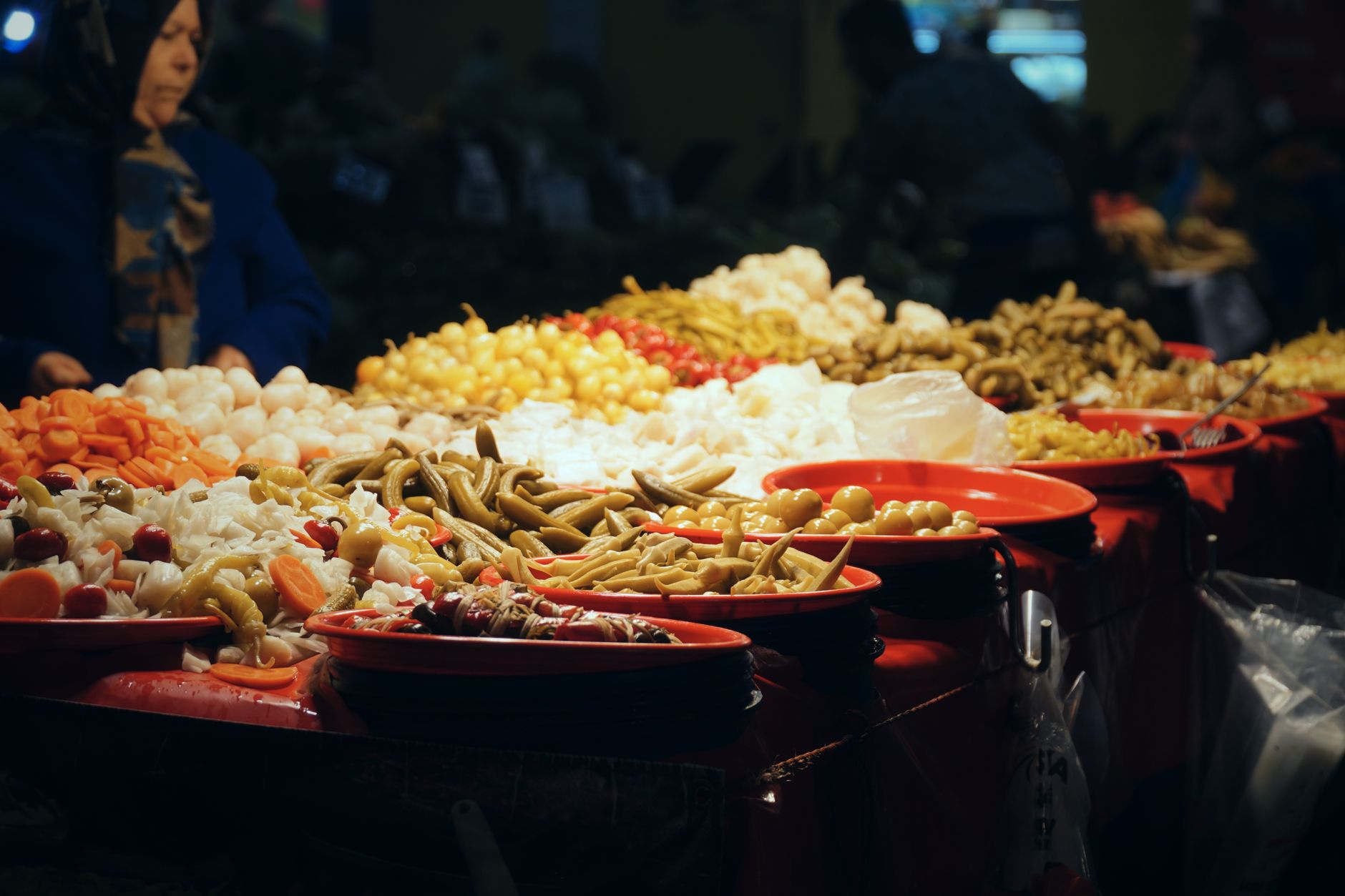
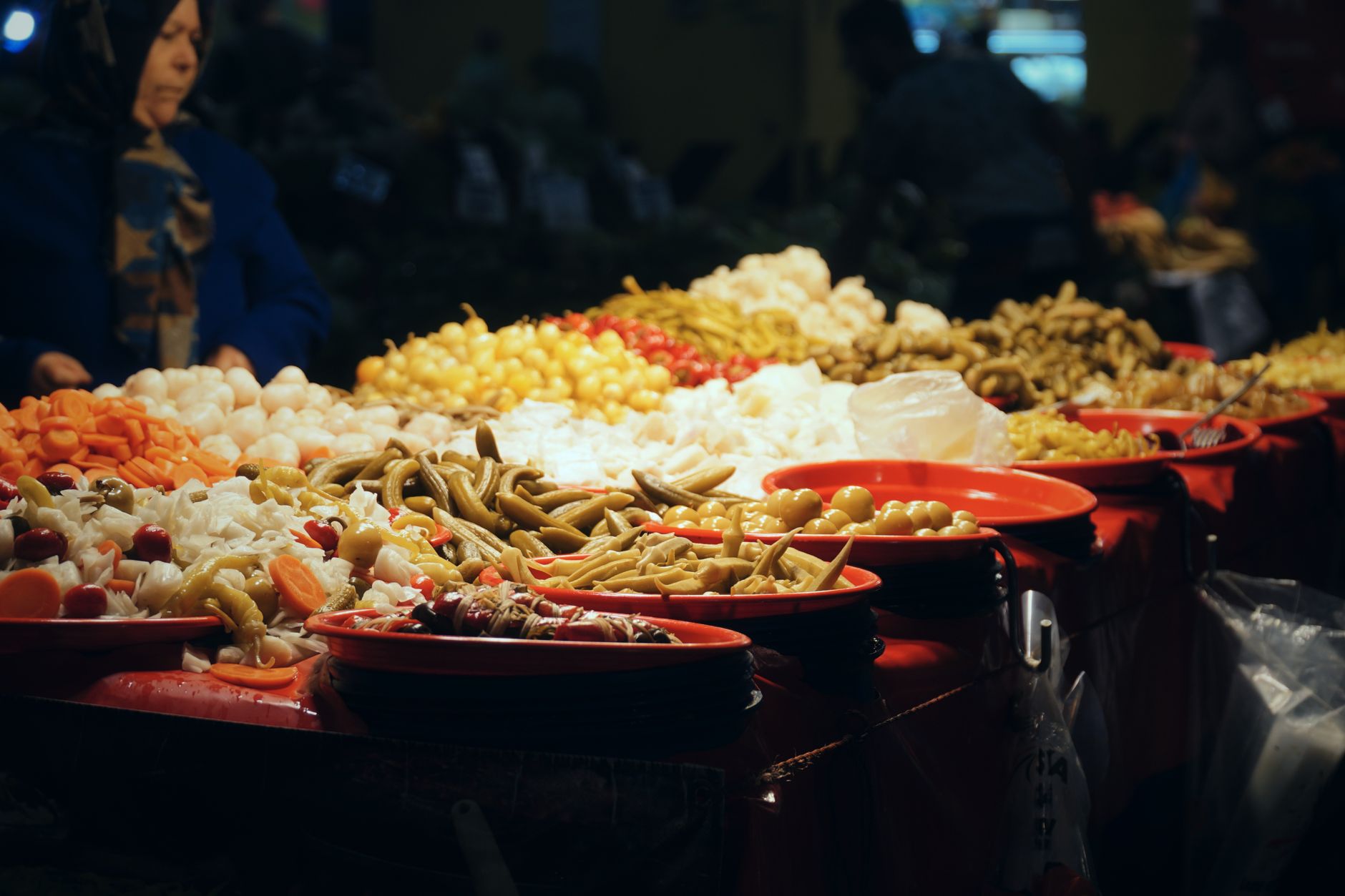
Yogurt and kefir with live cultures, kimchi, sauerkraut, miso, and tempeh add live microbes rather than just feeding existing ones. The best evidence here is a Stanford randomised trial (Wastyk et al., Cell, 2021): 36 adults spent 10 weeks on either a high-fermented-food or a high-fiber diet. The fermented-food group increased microbiome diversity and showed decreases in 19 inflammatory proteins, including interleukin-6.
The result that gets left out is more interesting: over those 10 weeks, the high-fiber group’s diversity did not rise. Fiber and fermented foods are not interchangeable. Fiber feeds the microbes you have; fermented foods introduce new ones. This is an argument for doing both, not for choosing.
4. Polyphenol-rich foods
Berries, green tea, dark chocolate, and extra-virgin olive oil contain plant compounds that gut bacteria convert into more absorbable, more active forms — a two-way relationship where the food feeds the microbes and the microbes unlock the food.
5. Variety, counted deliberately
Aim for many different plants each week rather than large amounts of a few. Herbs, spices, nuts, seeds, and whole grains all count, which makes 30 far more reachable than it sounds — a mixed-seed topping and a handful of herbs can add five in a single meal.
A simple weekly goal
| Goal | Why |
|---|---|
| 30+ different plant foods/week | Associated with greater microbiome diversity (American Gut Project) |
| Some fermented food daily | Raised diversity and lowered inflammatory markers in the Stanford trial |
| Build toward 25–38 g fiber/day | Substrate for butyrate, which fuels the colon lining |
| Limit ultra-processed foods | Associated with reduced diversity |
💡 Tip: “Eat the rainbow” isn’t only about vitamins — different coloured plants carry different fibers and polyphenols. Counting types of plants across a week (herbs and spices count) is a simpler target than tracking grams.
What harms gut health
- Diets very high in ultra-processed foods and added sugar
- Very low fiber intake — the most common problem by far
- Unnecessary antibiotics — essential when genuinely needed, but they disrupt gut bacteria for weeks to months, so use only as prescribed
- Adding fiber too suddenly. Gas and bloating from a jump in intake are usually a pacing problem, not an intolerance — increase by roughly 5 g a day each week and drink more water alongside it
Who should be cautious
“More fiber and more fermented food” is good general advice that does not fit everyone:
- Irritable bowel syndrome. Onions, garlic, legumes, and wheat are high in FODMAPs — the exact fermentable fibers that feed bacteria — and they are among the most common IBS triggers. A low-FODMAP approach, ideally with a dietitian, may matter more than maximising diversity.
- Inflammatory bowel disease during a flare. High-residue foods are often poorly tolerated when the bowel is inflamed. Follow your gastroenterology team rather than general population advice.
- Suspected SIBO. If bacteria have overgrown in the small intestine, feeding them more fermentable fiber can worsen symptoms.
- Significant immunosuppression. Live-culture foods introduce live organisms; check with your clinician first.
- Histamine intolerance. Fermented foods are naturally high in histamine and are a common trigger.
Persistent bloating, pain, blood in the stool, or unexplained weight loss are not dietary fine-tuning problems. They warrant a doctor, not a longer plant list.
FAQ
Q. Do I need a probiotic supplement?
Usually not. A fiber-rich, varied, plant-forward diet with some fermented food supports the gut without one, and dietary diversity is among the strongest predictors of a healthy microbiome. Supplements have specific, evidence-backed uses — antibiotic-associated diarrhoea, for instance — but “general gut health” is not a strong one.
Q. How fast can diet change my gut?
Composition can begin shifting within days. Meaningful, durable change is a matter of weeks to months — the Stanford trial ran 10 weeks to see its effects. A three-day “gut reset” is marketing.
Q. Do I really have to count to 30?
No. Thirty is a memorable target from one observational comparison, not a threshold you cross into health. If you currently eat six or seven plant types a week, going to fifteen is the meaningful move.
Q. Are fermented foods safe for everyone?
Most people tolerate them well. Introduce them gradually to avoid temporary gas, and see the cautions above if you are immunocompromised or histamine-sensitive.
Sources
- Harvard T.H. Chan School of Public Health — The Microbiome
- Stanford Medicine — Fermented-food diet increases microbiome diversity, lowers inflammation (Wastyk et al., Cell, 2021)
- McDonald et al., mSystems 2018 — American Gut: an Open Platform for Citizen Science Microbiome Research
- Mayo Clinic — Dietary fiber: essential for a healthy diet
⚠️ Medical disclaimer: This article is for general information only and is not a substitute for medical advice. Consult a professional if you have a digestive condition.

Leave a Reply