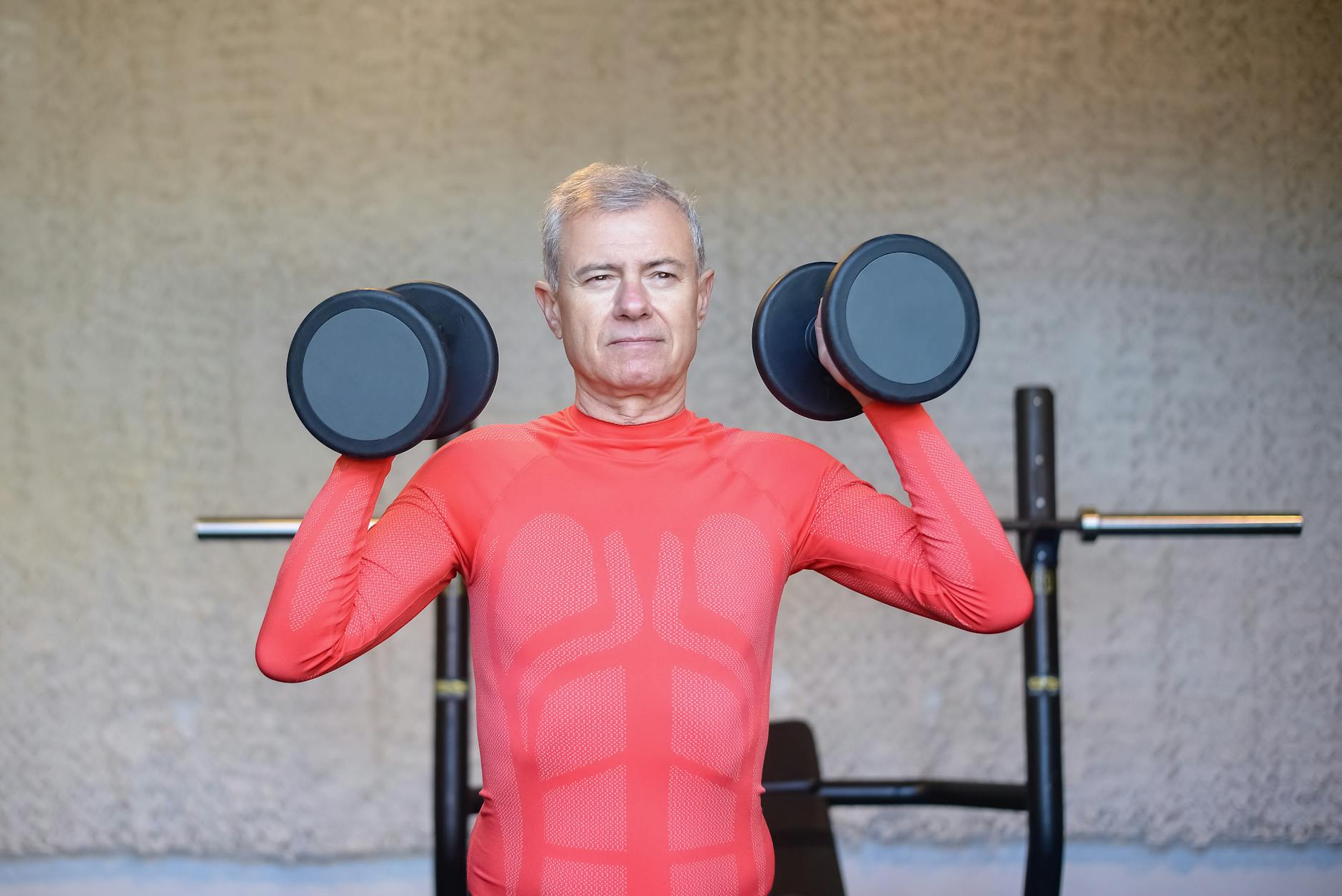
Cardio gets the spotlight, but if you want to stay strong, steady, and independent as you age, muscle is the asset to protect. Losing it is not a cosmetic problem — it is the mechanism behind a lot of what people call “getting old.” Here is what the decline actually looks like in numbers, what training does about it, and how late is genuinely too late.

What you actually lose, and when
From around age 30, adults lose roughly 3–5% of muscle mass per decade without a training stimulus — and the rate accelerates after 60. The clinical name is sarcopenia.
Two details matter more than the headline figure:
- Strength falls faster than mass. You lose power — the ability to produce force quickly — earlier and more steeply than you lose bulk. Power is what catches you when you trip, which is why it matters out of proportion to how it looks.
- The loss is not evenly distributed. Type II fast-twitch fibres, the ones used for fast, forceful movement, shrink most. This is why rising from a low chair or climbing stairs quickly becomes hard before anything else does.
Muscle also does metabolic work: it is the largest site of glucose disposal in the body, so losing it worsens blood sugar control independently of weight.
How late is too late?
The reference point here is a small, famous study: Fiatarone et al., JAMA 1990, which put frail nursing-home residents aged 86 to 96 through eight weeks of high-intensity resistance training. Muscle strength rose by an average of about 174%, with measurable increases in muscle area and walking speed.
Read that number honestly. It was ten participants, and gains of that size are possible precisely because they started so deconditioned — someone already active will not see 174%. What the study established is the principle, and it has held up since: muscle remains responsive to training into the tenth decade of life. There is no age at which starting stops working.
The longevity link — and what it does and doesn’t mean
People with more muscle and stronger grip tend to live longer and stay functionally independent, and grip strength predicts mortality better than blood pressure in some cohorts. But this is association, and the direction is not simple: illness causes weakness as well as the other way round.
The honest version is that grip strength is a window onto whole-body strength and health, not a lever you pull directly — squeezing a hand gripper does not buy you the outcome. The grip strength article covers that distinction in detail.
How much, and how often
- 2–3 sessions a week, non-consecutive days. Two is enough to make progress; three is better if it fits
- Cover the major patterns: squat or sit-to-stand, hinge, push, pull, carry
- 8–12 repetitions per set, 1–3 sets, with the last couple of reps genuinely hard
- Progressive overload — add a little resistance, a rep, or a set over time. Doing the same thing for a year maintains rather than builds
- Include something fast once you are established — standing up quickly, a brisk step-up. Power training targets the fibres that decline first
The most common mistake is not intensity but coasting: staying at a weight that stopped being challenging months ago.
It’s not just heavy weights
Bodyweight squats, sit-to-stands from a chair, wall push-ups, resistance bands, and carrying shopping all build strength. Form comes before load, and the best programme is the one you do twice a week for years.
Pair it with protein
Training is the signal; protein is the material. Older adults face anabolic resistance — the same amount of protein produces less muscle-building response than it did at 30 — so requirements go up with age, exactly when appetite and intake tend to fall.
- Commonly advised: 1.0–1.2 g per kg of body weight per day for older adults, above the 0.8 g/kg RDA
- Roughly 25–30 g per meal appears to be the threshold that triggers muscle protein synthesis
- Spread it out. A protein-light breakfast followed by a large dinner wastes part of the day
💡 Tip: Work out your own number with the protein calculator, then check breakfast first — it is almost always the meal that falls short.
Beyond muscle: balance and bones
Strength work improves balance, and it loads bone in the way bone responds to. Both feed the same outcome: fractures come from falls, and falls come from being unable to correct a stumble. Functional movements — standing up, stepping up, lifting, carrying — transfer directly to the situations where that matters.
Who should be cautious
- Uncontrolled high blood pressure or known heart disease. Straining against a heavy load with a held breath spikes blood pressure. Get clearance, keep breathing through reps, and avoid maximal efforts until advised otherwise.
- Recent surgery, hernia, or retinal problems. All are affected by the pressure generated during heavy lifting. Ask before loading.
- Osteoporosis or vertebral fracture history. Resistance training is recommended, but loaded spinal flexion — bent-over rows with a rounded back, weighted sit-ups — is not. This needs a programme designed for it, not a generic one.
- Joint replacement or significant arthritis. Usually a matter of choosing ranges and movements, not avoiding training. A physiotherapist is worth one session.
- Chronic kidney disease. The higher protein targets above are general advice and do not apply; take an individual target from your clinician.
Stop for chest pain, dizziness, or new joint pain that persists beyond a session, and get it assessed rather than trained through.
FAQ
Q. Is it too late to start?
No. The Fiatarone trial showed large strength gains in 86-to-96-year-old nursing home residents over eight weeks. Muscle responds at every age — the size of the response depends on how deconditioned you are, not on the number.
Q. Do I need a gym or heavy weights?
No. Bodyweight, bands, and household objects work, particularly at first. What matters is that the last repetitions are hard and that the challenge increases over time.
Q. How soon will I see results?
Strength improves within a few weeks, mostly through neural adaptation — your nervous system recruiting muscle better before the muscle itself changes. Visible size and functional gains take a couple of months of consistency.
Q. Two sessions a week — is that really enough?
Yes, for most people, if you progress the load. Two well-executed sessions beat four you abandon in March.
Q. Should I do cardio too?
Yes — they do different jobs, and neither substitutes for the other. Strength protects muscle, bone, and independence; aerobic work covers cardiovascular and metabolic ground that lifting does not.
Sources
- Fiatarone et al., JAMA 1990 — High-intensity strength training in nonagenarians
- National Institute on Aging — Exercise and physical activity
- American College of Sports Medicine — Resource library
- Cleveland Clinic — Sarcopenia
⚠️ Medical disclaimer: This article is for general information only and is not a substitute for medical advice. If you have a health condition or are new to exercise, talk to a qualified professional before starting a strength program.



Leave a Reply